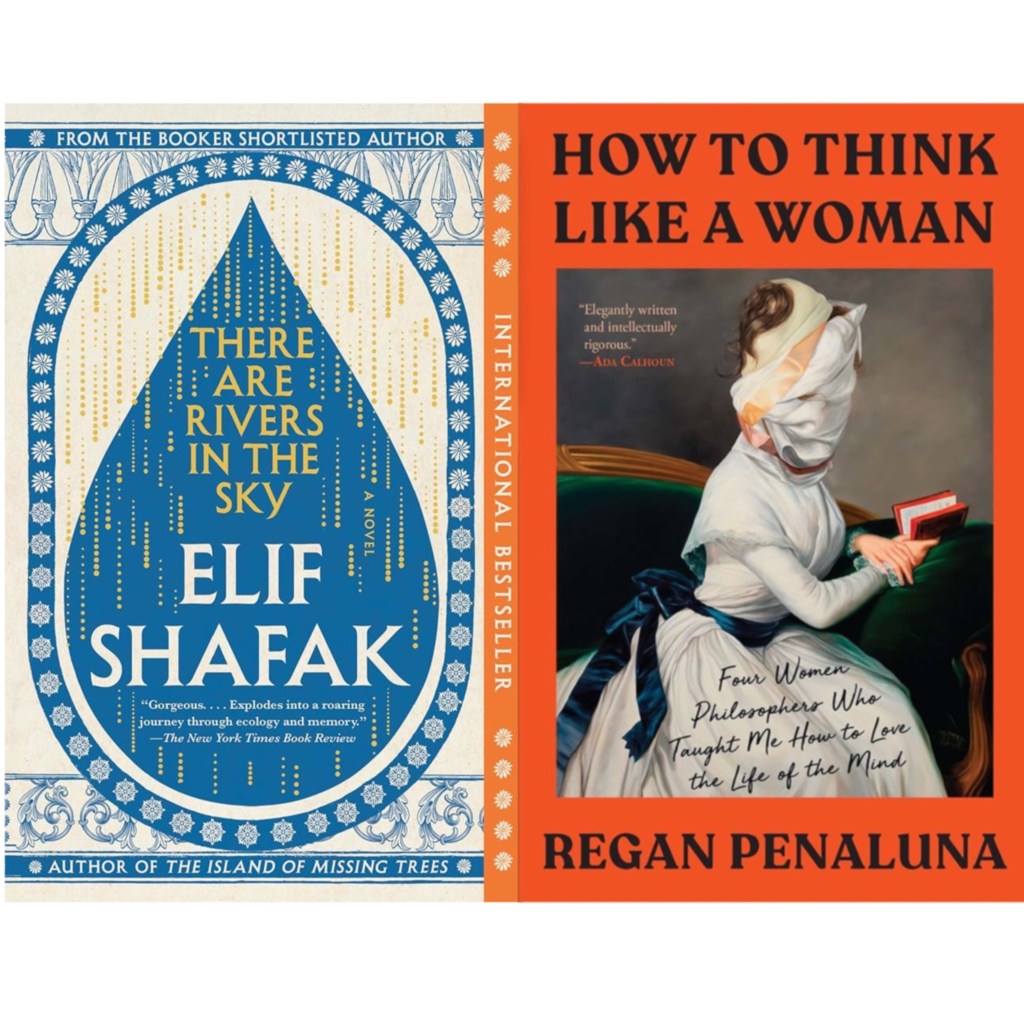
I thoroughly enjoyed both books. The only woman philosopher I had heard of prior to reading was Aspasia, the forgotten teacher of Socrates, so How To Think Like a Woman was enlightening, and I was intrigued to discover there had been woman philosophers as early as the 15th century, if not earlier (Demaris Cudworth Masham (1659-1708), Mary Astell (1666-1731), Catharine Cockburn (1674 or 1679-1749), and Mary Wollstonecraft (1759-1797)). I love memoirs and autobiographies because I believe everyone has a story to tell and I enjoy getting to read those of whom put theirs to print. There’s something heartwarming about reading someone’s story in all its honesty and even if we readers are completely different from the authors we read, there is always that common ground of being a human moving through life in their own way and thus, you are connected to what you are reading in a different way than fiction. I got to follow Penaluna through her time as a younger university student and as an older adult professor and graduate student grappling with being a woman in a male-dominated field and the implications of that on her life and study; it was immensely informative as well as uplifting as she progressively gets more and more sure of herself, her research, and why the philosophers she highlights have affected her the way they did. Coming off a nonfiction read that was difficult to finish due to my dislike of the author’s prose/style, Penaluna’s was smooth and very easy to read. I enjoyed the voice of her story.
I felt the same about Shafak’s writing in There Are Rivers in the Sky. At times, I was washed away (wink wink) by a line or lines that I was stunned someone could create and weave into such an already beautifully constructed narrative. I have read a myriad of other books that follow multiple POVs throughout, but Shafak was able to add her own spin on the structure and it succeeded in captivating me. Her worldbuilding was phenomenal and the book only got better as I read and began seeing the connections between the three characters and stories we follow and to have it all culminate in the ending the way it did genuinely moved me. Through Shafak’s writing and storytelling, I did not even realize how much I had come to care for the three main characters, and I was sad to see them go when I finished reading. Even though their stories are complete by the end, as Anakin Skywalker once said, “I want more, but I know I shouldn’t.”
Commonalities
Penaluna & Zaleekhah
Zaleekhah is one of our three main characters in There Are Rivers in the Sky. She is a hydrologist who rents a houseboat on the River Thames with the intent of eventually taking her own life. The simplest commonality already is both Penaluna and Zaleekhah being women in academia, but it goes deeper than that. How to Think Like a Womanfrequently included moments of Penaluna questioning why she was studying philosophy in the first place, let alone a niche field within an already niche field. Her self-doubt was only amplified by the misogyny (both implicit and explicit) that came with 1) simply being a woman and 2) being a woman studying in an almost literally male-dominated field. We also see Zaleekhah struggle with the reasonings behind her study and her motivation to continue as she navigates an impending divorce and the unhealed trauma from the loss of her parents in a flood when she was a child. We learn that Zaleekhah had been taking up the reigns of her previous colleague who became invested in a theory that water has memory which was not taken seriously by the rest of the scientific community, and he was thus, promptly laughed out of his academic circles. This also played a part in what led to her divorce. Two women studying something niche and seemingly trivial to others, but personal to both in a way that ultimately kept them going.
Penaluna’s discovery of the four philosophers she discusses invigorated her study as she was able to see other women living the life of the mind that she desired, in an even more restrictive era of history for women. The more she discovered, the more she became invested in unearthing the lives and writings of these philosophers previously lost to the archives. Zaleekhah does not prove or disprove her colleague’s theory in the novel, but she meets Nen, the owner of the houseboat and forms a bond with her that by the end, I feel, keeps Zaleekhah alive. Nen helps reorient the way Zaleekhah thinks and goes about life and her research and is able to help Zaleekhah see her own limitations to begin to surpass them and evolve as a person and character. Where once Zaleekhah was determined to rid herself of the burden of life, Nen provided a much-needed boost to strengthen Zaleekhah’s resolve. Both Penaluna and Zaleekhah were helped along on their journeys by women they cared about.
Recovering the Past
A commonality I noticed throughout both books was the theme of recovering the past. In How to Think Like a Woman, we see Penaluna discover the lives and works of four philosophers dating back to the 15th century and in There Are Rivers in the Sky, we see one of our main three characters, Arthur Smyth, decipher and unearth (another wink wink) the Mesopotamian clay tablets that preserved the Epic of Gilgamesh.
When discussing each of the four philosophers, Penaluna first gives us readers a glimpse into these women’s lives and how they navigated pursuing philosophy in the times they did—which required important historical and societal context—before diving into how discovering them affected Penaluna’s own life and study of philosophy. We see these women pursue philosophy and education in an age where all society expected a woman to do was get married and rear children. We see them challenge the prevalent ideas that centered around the self, logic/reason, religion, free will, and other important philosophical topics being discussed by the minds of that time including names almost everyone is familiar with when it comes to philosophy: Rousseau, Locke, Malebranche, Montesquieu, Newton, Voltaire, etc. These four women stood toe-to-toe with their male counterparts and managed to carve out their own piece of philosophical history, even if that piece was much smaller than others. Arthur Smyth’s narrative in There Are Rivers in the Sky takes place in 17th century London and Shafak paints a painful yet historically accurate picture of what it was like for Arthur living in poverty in a place like London during this time. Arthur becomes infatuated with the British Museum and eventually earns a position there once the Director of Antiquities realizes Arthur can decipher the ancient language written on the clay tablets. We follow Arthur on his discovery of the Epic of Gilgamesh which at the time was monumental since it provided evidence of the Great Flood that predated the Bible. As Arthur progresses, it becomes clear there is a tablet missing and we later travel with Arthur on a chartered expedition to Nineveh where he tries and succeeds in excavating the lost tablet and completing the epic. We also see Arthur grapple with the implications of taking something from its native land/people under the guise of “preservation” because of the belief that it is safer in his hands and what it means that the artifacts are now thousands of miles away out of reach of those with whom it and its history originated.
Forgotten Women
Aside from the connections to herself and her research, Penaluna’s memoir is entirely about forgotten women. Philosophy has been primarily if not wholly defined by its male contributors and I feel confident in the assertion that most people have not heard of the four philosophers Penaluna discusses; I know I certainly had not. While we have a wealth of works from the prominent male philosophers as those were always the works studied, it was repeatedly mentioned by Penaluna how most of the works of the four women had been lost to history or were never given the opportunity for preservation in the first place. It took steadfast research on Penaluna’s account to discover the works of these women and let alone enough works and history that had survived long enough to make its way into Penaluna’s hands. And even then, it was also consistently noted that works of some of these women had been completely lost.
In There Are Rivers in the Sky, the forgotten woman is the goddess Nisaba. The novel starts with a focus not on any of our three main characters, but on the Assyrian King Ashurbanipal in his storied library where he secretly gazes on a blue tablet of the Epic of Gilgamesh that is dedicated to Nisaba, the goddess of storytelling. This dedication made the tablet illegal as all scribes were to dedicate their writings to the god Nabu instead. Shafak details a history that Nisaba was originally the goddess of storytelling and when women were allowed an education and to become scribes, all works were dedicated to her. As powers changed, so did the gender in favor. Women were barred from education and scribe schools and Nisaba was replaced with the male god Nabu because “…writing is a ‘manly task’ that requires a virile patron, a male god.” Later, Nen also references Nisaba in conversation with Zaleekhah and asks, “Why are women left out of history? Why do we have to piece their stories back together from fragments – like broken shards of pottery?” During the novel’s start when we follow King Ashurbanipal, this sentiment is also expressed when Shafak details the various artworks that line the king’s halls. “All the pictures depict the splendor of the Assyrian Empire, the superiority of men and the grandeur of the emperor. There are almost no women to be seen.” There was one woman in all the works, Ashurbanipal’s wife who is painted next to him as they feast on a picnic in a garden, surrounded by spikes adorned with the heads of Ashurbanipal’s enemies.
 Commonalities
Leave a comment