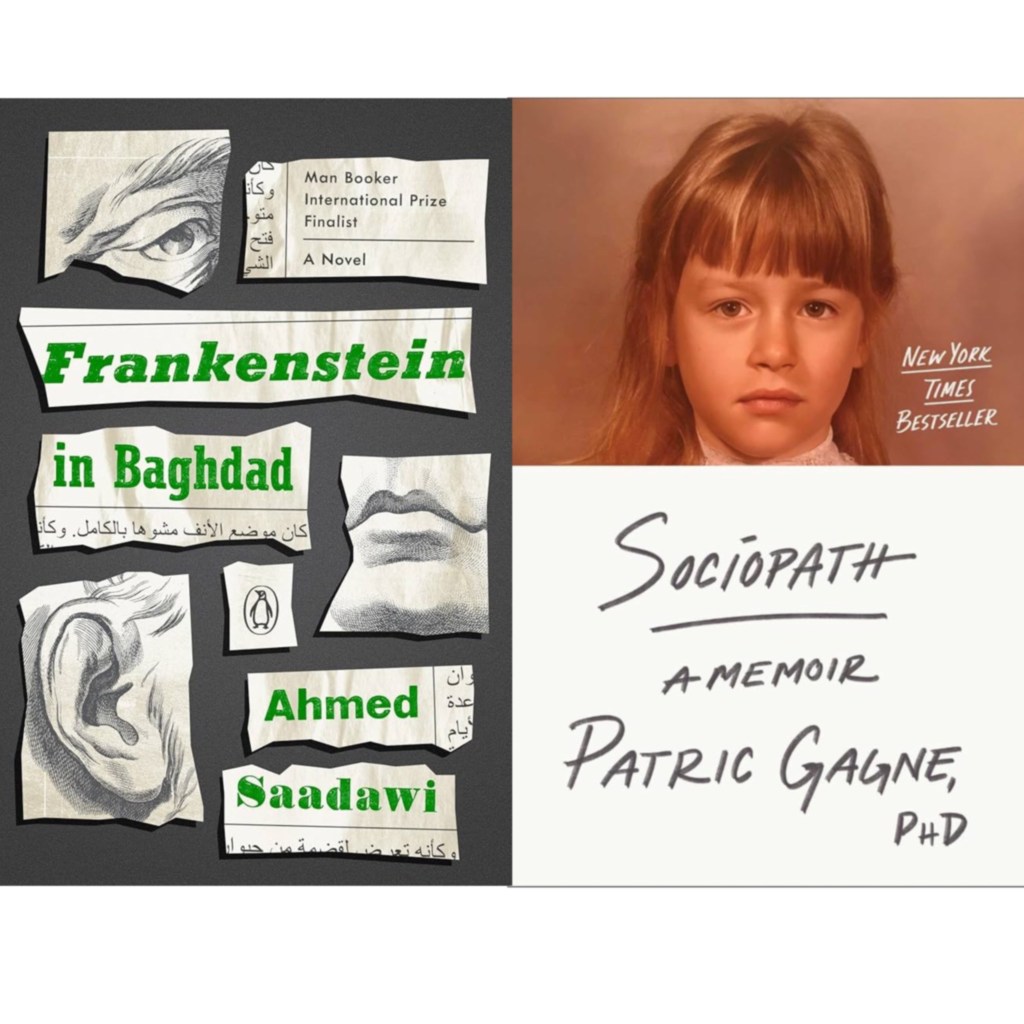
My second draw for Commonalities proved also very enjoyable. Piggybacking off my first post and my comments about memoirs, Sociopath was also extremely enlightening and interesting to read. It floored me how Gagne could even remember so much about her life in such explicit detail to recount in this book, at some points it felt like I was reading a novel. You truly get to see her life as a sociopath from elementary school age – as early as she could understand her feelings and that she was different than other children – to adulthood and she gives countless anecdotes that make you feel like you are moving through life right with her. The insights into sociopathy as well were titillating to say the least, as someone with a minor and casual interest in psychology. Gagne explains her thoughts and feelings (or lack thereof) in a way that is so approachable to an unknowing reader, and I left with a much deeper understanding of sociopathy thanks to her writing and story. We, as a society, tend to apply prejudices and generalizations to things we fear or just do not understand, and sociopathy is no exception. Gagne, however, skillfully breaks down these common ideas and shows what life is really like for someone diagnosed with sociopathy, and it’s a lot different than I’m sure a lot of us would imagine.
While Sociopath scratched my itch for psychology, as an enthusiast of anything having to do with Mary Shelley’s Frankenstein, I was thrilled to discover Frankenstein in Baghdad even existed. I was even more thrilled to receive it as a birthday gift. I taught Mary Shelley’s Frankenstein to my tenth graders in 2024, the same year I also discovered and read the Frankenstein-inspired Our Hideous Progeny by C.E. McGill. I reread the original novel myself in 2025 in preparation for Guillermo Del Toro’s film adaptation, and now I was getting to stitch another piece into my Frankenstein-ian collection. While the backdrop of contemporary Iraq and U.S.-occupied Baghdad takes center stage more so than the themes prevalent in the original text, I felt I was on a literary scavenger hunt almost to discover the similarities that made this a Frankenstein-adjacent novel. There is a much larger cast of characters that we follow intermittently throughout which definitely added more flavor to the story, however, my only real critique is that we get less of the creature’s (or in this case, the Whatsitsname’s) POV. There is also a deeper spiritual/religious aspect to Frankenstein in Baghdad that played an interesting role in the story and also added to the novel’s uniqueness from the Muslim faith, blind belief to the point of fanaticism, to the Tracking and Pursuit Department, a special information unit set up by the U.S. that employed, “…analysts in parapsychology, astrologers, people who specialize in communication with djinn, and soothsayers.” The department’s mission was to monitor unusual crimes, urban legends, and superstitious rumors that arose around specific incidents, and then to find out what really happened, and to make predictions about crimes that would take place in the future (sound familiar my fellow CIA conspiracy theorists?).
Commonalities
Elishva and Patric’s Abnormal Behavior
Elishva is one of the first characters we meet in Frankenstein in Baghdad and in short, she fits the archetype of the “crazy, old woman” character. Despite all her family having moved out of Baghdad due to the growing conflict and pressing her to do the same, Elishva stays put in her dilapidated and decaying house waiting for her son Daniel to return from the war even though it has been many years. Throughout the novel, Elishva conversates with one of her mangy cats named Nabu and a painting of Saint George the Martyr, as if they were relatives living with her. When the Whatsitsname appears in the story (he is constructed in a “hovel” of sorts across the street from Elishva and later finds refuge in her house), Elishva takes him to be the specter of her son Daniel finally returned and treats him as such, caring for him, feeding him, and giving him Daniel’s clothes to wear. Her abnormal behavior is encapsulated in the quote, “To others she lived alone, but she believed she lived with the three beings, or three ghosts, with so much power and presence that she didn’t feel lonely.” Some who lived around Elishva or knew her even believed she had powers and could influence future events.
Gagne, on the other hand, constantly felt lonely due to her abnormal behavior. The biggest factor of her sociopathy was apathy. She knew the feelings she was supposed to feel, but just could not feel them herself, especially when learning between right and wrong as a child. “I may have been missing an emotional connection to the concepts of right and wrong, but I knew they existed.” She knew when she did something “bad,” she just never felt the usual remorse or guilt afterwards. Her routine acts of stealing, trespassing, stalking, and sometimes violence are all things we would classify as abnormal behavior, but for Gagne, they were behaviors she had to do to distract from the apathy that she described as a pressure that built up in her head that could only be released by doing something “bad” that would give her a jolt of feeling to at least prove she could feel something. As such, she was often alienated from friend groups and did not socialize much with other children her age growing up. Stabbing a classmate with a pencil, leaving a sleepover in the middle of the night by herself to walk home, and tricking her neighbor’s children into going outside, only to lock them out and ditch them, being just a few examples. As an adult, these behaviors progressed to stealing cars, trespassing either in vacant houses or after breaking and entering into someone’s actual house, and attending funerals. The last she described as surprisingly helping because, “It was as though I was escaping apathy through osmosis.” The intense feelings that usually accompanied a funeral were so strong, it helped Patric just to be in that kind of space to counter her apathy.
Whatsitsname’s Followers, David, and Max
In Frankenstein in Baghdad, the Whatsitsname builds a mythology around himself throughout the novel as he seeks to avenge the deaths of the victims of the war and frequent car bombings that he is made up of so their souls could rest in peace. Hadi, a junk dealer and the Whatsitsname’s creator, is known for telling wild stories to any who listen at a local coffee shop and spins his own Whatsitsname story as the novel’s events play out that adds to the mythology as well. This grows to a point where the Whatsitsname gains devout followers: the Magician, the Sophist, and the Enemy are the main three and there is also a young, old, and eldest madman. They aide the Whatsitsname by protecting it and helping it find and add new parts to its body when previous parts start to fall away (in the novel, the Whatsitsname believes that the pieces fall away if he takes too long to avenge the owner of the specific body part). The Magician and Sophist serve as spiritual and logical advisors of sorts to the Whatsitsname but begin to contradict each other and the Sophist ultimately ends up murdering the Magician in the midst of an armed conflict at their common dwelling. The Enemy is an inside man with the military and would provide the Whatsitsname with the locations and movements of military units in the area to help the Whatsitsname avoid capture, he is later found out but we don’t know if he lives or dies. The three madmen break off and build factions of their own centered around their differing beliefs of who or what (wink wink) the Whatsitsname is, but they also begin to clash culminating in the very armed conflict that brought about the Magician’s murder at the hand of the Sophist. In the end, I felt none of the Whatsitsname’s followers influenced him in a positive way and as they broke away or perished in the conflict, the Whatsitsname was thus, left alone.
Gagne still experiences relationships throughout her memoir, both platonic and romantic. She meets David at a summer camp, and they immediately click because David does not judge her about her sociopathy and thus, she opens up to him about how it affects her and he genuinely listens and supports her. He also encourages some of her sociopathic tendencies during camp, like stealing a map of supposed underground tunnels and following her on secret excursions when she does eventually discover them. By the end of the memoir, Gagne and David are married with children, but their relationship had not been without its ups and downs. I would say David was both a positive and negative influence on Gagne, more negative when they were younger and more naïve, but he provided a relationship to Gagne that she could trust and be happy in and that had I’d say the most positive influence on her in the end. David had problems of his own with how he treated Patric and her sociopathy as someone who was not a sociopath, but they eventually went to couples therapy and worked it out together. A large part of her memoir involves her career in the music industry working in management with her father where she meets Max, a musician. During a break in her and David’s relationship, and sometimes during, she became close to Max, not in a romantic way but to anyone who reads, it would seem more than just friends. Max encourages Gagne’s sociopathic behavior often to her detriment and she even brings him along on one of her stalking excursions to watch the mother of a musician Patric’s father had turned down but who had been blackmailing Patric in an attempt to save her son’s perceived fame. Gagne knew her relationship with Max did not do her good, but she still needed that jolt of feeling every now and then and at the time, Max was the perfect hit. Their “relationship” ended when Max made a move due to his developed feelings for Patric, that she of course did not reciprocate. We are all influenced by those around us, and Patric and the Whatsitsname were no exception.
The Goals of Hadi and Patric
The synopsis on the back of Frankenstein in Baghdad described the Whatsitsname’s creation as being motivated by Hadi wanting the stitched together parts (all that were left of those killed by the car bombings) to be recognized as a person by the government so it could receive a proper burial. I anticipated the novel going into detail about this and explore the themes of personhood regarding the titular “creature,” along with the implications regarding the carnage left behind by the violence of war, but that was not really present or discussed much. The novel was definitely more character driven and Hadi’s motivation in creating the Whatsitsname was more so touched on in passing. So, the fact Hadi had his goal in mind for creating the Whatsitsname is the sole commonality with Patric’s goal(s).
Patric had many goals she outlined in her memoir. She sought to understand herself and her sociopathy to help other sociopaths do the same as she frequently encountered gaps in research or therapies for those diagnosed with sociopathy. How was she supposed to help/treat herself when there was not much definitive research into sociopathy in the first place? Patric even recounts her discovery that sociopathy was not even listed in the DSM-V, and by that time, it was commonly grouped under antisocial personality disorder, despite sociopathy having different characteristics, and despite most psychological disorders presenting differently in different people. She also knew how the world regarded those deemed “sociopaths” which only further alienated them and thus, fed into their bad behaviors. Patric sought to find a better definition and treatment for sociopathy by digging into its roots in anxiety and what Patric described as the “stuck stress” she would feel due to the overabundance of apathy. That became the foundation of her research and I hope that other sociopaths were able to read Patric’s memoir and experience that one-of-a-kind feeling when you encounter something or someone that is able to perfectly describe what you thought was indescribable or purely singular to you.
 Commonalities
Leave a comment