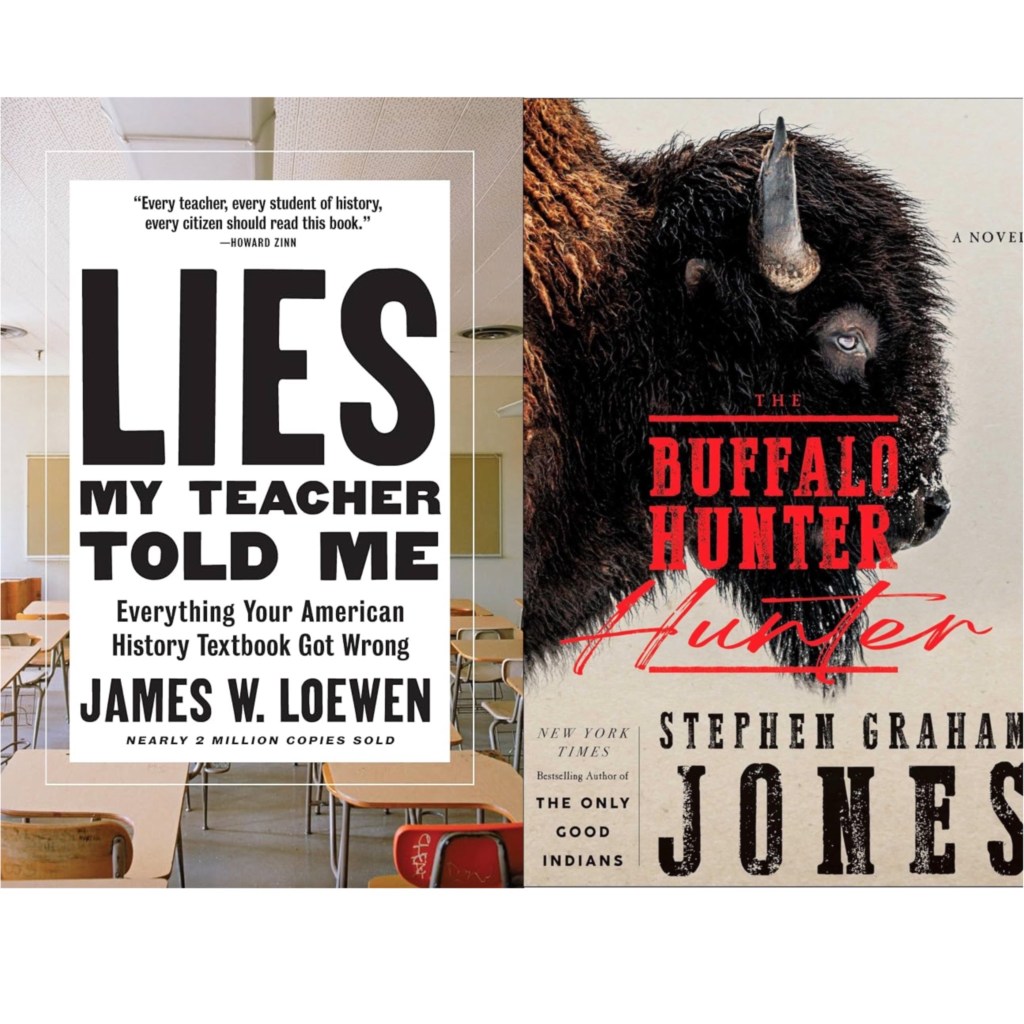
I’m sure I’ll have other favorite pairings by the time I finish the first set of pairs for this project, but for now, this one holds the top spot. Both books left an impact on me; one that I feel will be lasting. As a teacher, Lies My Teacher Told Me stuck out like a sore thumb on the bookstore shelf and I couldn’t resist reading about something so close to home. When I decided to pursue a career in education in sixth grade, at first, I wanted to be history teacher but pivoted to English because at the time, I didn’t feel confident in my ability to learn/remember all the necessary dates, time periods, years, etc. that would come with teaching a history class. This is humorous in hindsight, because I currently hold certifications to teach both English and Social Studies. I already knew of the whitewashing of history that is and has been taught in most, if not all public schools, but Lies really put it into perspective just how much was covered up, minimized, or just outright not acknowledged in the array of American History textbooks that circulated public schools around the years of the late 90’s to early 2000’s and the problems this posed for students, teachers, or anyone trying to learn the subject. If I were to ever teach American History, I would come back to this book as a useful resource when approaching how to work with (or against) my given textbook to produce educated and informed citizens, the ultimate goal of a social studies classes. Lies covered a range of topics in American History, but for this post and pairing, I’ll be focusing mainly on the chapter “Red Eyes,” about the “lies” told regarding the history of Native Americans in the United States.
When my partner, AJ, picked up The Buffalo Hunter Hunter, neither of us knew much of the book’s subject, just that it had been receiving rave reviews as a Western horror novel. After finishing, I can say this book is among my all-time favorites. It is similar to Mary Shelley’s Frankenstein in that it contains a story within a story within a story. In short, we follow a graduate student who was given the journal of a long-lost family member found in the remains of an old church. The journal contains the story of this family member, a preacher in a Montana town circa the late 1800’s to early 1900’s grappling with a series of murders and within the preacher’s journal, we read the story of Good Stab, an Indian who has sought out the preacher to take his confession. Said confession involves a wild and horrific tale of how Good Stab was turned into a vampire and how the events of his life have led him to the preacher’s church doors. As a lover of anything vampire-related, this was a deliciously unexpected surprise, and I thoroughly enjoyed Jones’ take on common vampiric tropes in this setting and with these characters. I will say too, not for a lack of interest, but horror novels aren’t typically high on my want-to-read list. I know they are meant to be scary but even though I love horror movies, horror novels never achieved the same effect. Maybe it was due to the difference between reading words on a page versus seeing something play out in visceral detail in a movie or TV show; the words only did so much. The Buffalo Hunter Hunter, however, contained some of the grisliest horror scenes I had ever read and genuinely made me shudder at times. Reading about the pitfalls of how Native American history is presented in history textbooks while also reading an account from a vampiric Native American and how he moved through his life and encounters with white settlers and buffalo hunters, was thrilling to say the least. The commonalities were as abundant as the blood flowing through the pages of The Buffalo Hunter Hunter and that covers the land we call America.
Commonalities
Native American/Indian Stereotypes
One of the “lies” Loewen discusses in the “Red Eyes” chapter is how we were typically taught to regard Native Americans and their ways of life as primitive, compared to the sophisticated European settlers. So much so that, “Our archetypes of the ‘virgin continent’ and its ‘primitive tribe[s]’ subtly influenced estimates of Native populations.” For example, textbooks estimated only less than one million for the total population of Native Americans when in reality, the populations were closer to between 10 and 20 million. History being told through the eyes of the white settlers would of course downgrade Native societies as primitive and savage, even though without the help of Native Americans, many settlers and colonies would have died off due to their inability to survive on their own on the new land. These stereotypes were then used to justify the displacement, killing, and overall attitude towards Native American communities. Since European settlers were so superior, it was only logical that their ways would only better the lives of the Native Americans and as settlements grew and more settlers arrived on America’s shores, where else to go than further into Native American land. It only takes a small amount of research to understand that in fact, European settlers in the early years decimated Native American tribes due to the new diseases they introduced and their own savagery towards the tribes they saw were encroaching on their “destiny.” Early accounts even document European settlers stealing from tribes to fortify their own homes, which prompted the Native Americans to either confront or steal back their belongings, which was used to justify violence against them. A vicious cycle that still plays out to this day. These stereotypes are further reinforced in American History textbooks, leading students to believe that the first settlers stumbled upon wild and untamed land which was only cultivated and grew into early America through European settlement. How had the Native Americans survived for so long before their arrival I wonder?
Native American/Indian stereotypes are reinforced in The Buffalo Hunter Hunter through the language used by Arthur Beaucarne, the pastor and one of our main characters. He frequently uses words/phrases like “savage,” “your people,” when referring to Native Americans and using the color red to describe Good Stab’s skin. He assumes their primitive lifestyle compared to his own and that of the Montana town. His thoughts and language also reinforce other stereotypes of Native Americans present in that time in history including, “…[Native American’s] way [of] seek[ing] handouts instead of bending their backs to the plow,” and “…Indians having an inbuilt sense to avoid anyone in uniform or with credentials granting them authority.” Of course, Native Americans did come to rely on government assistance but only after they were forced into reservations and the government became their only source of consistent food and shelter. And I don’t think I even need to explain the irony of thinking Native Americans didn’t work hard to live off the land and “bend their backs to the plow.” And, if you had witnessed strange men in strange clothes asserting supposed authority over you in a language you didn’t understand to take your land, animals, and kill your families/tribes over decades, would you not also grow to be wary or resent people similar? We tend to treat Native American violence towards white settlers as proof of their supposed savagery instead of acknowledging the settler’s and American government’s actions to incite and provoke the violence themselves through the taking of their land, elimination of their hunting grounds, buffalo, and other animal populations they depended on for food and clothing, and the killing of their loved ones. The Native Americans were only trying to survive in the midst of, by definition, an invasion under the guise of Manifest Destiny. This is put succinctly in an exchange between Beaucarne and Good Stab,
“You can’t stop a country from happening, Good Stab.”
“But we were already a nation.”
Vampiric Aspirations
Reading the term Manifest Destiny in the previous paragraph probably tickled something in the back of your brain from a long-ago history class, as it is one of the more common vocabulary terms students learn. According to the Smithsonian Institution, Manifest Destiny was “the philosophy describing the necessary expansion of the [American] nation westward…the belief that it was our duty to settle the continent, conquer, and prosper.” I chuckled when I read the word “necessary.” Students typically learn why this was the motivation for westward expansion and how difficult the migration was for the settlers themselves, but that’s where it ends. It’s either glossed over or ignored entirely the peoples and land we displaced and/or destroyed along the way and the violence we perpetrated to do so. Where American History textbooks fall short, however, the Smithsonian Institute does acknowledge it, “This ideology served as justification for the violent displacement of native peoples and the forceful takeovers of land by military means.” And even then, this is only one sentence with no description of the specific events or occurrences of whose scars are still felt by Native American communities. Like how a vampire drains its victims of their blood, so the settlers drained early America of its native populations and lands.
Jones employs quite a few of the typical vampire tropes in The Buffalo Hunter Hunter, but does so with unique features that set it apart in the pantheon of vampire fiction; their bloodthirsty violence of course remaining a primary characteristic. Good Stab is not the first vampire we meet in this story; it is one who Good Stab refers to by the name Cat Man. This is due to his appearance when Good Stab first laid eyes on him. One of the unique spins Jones puts on the vampire is that they take on the characteristics of what they “eat.” Cat Man had been in the plains for so long and had only feasted on larger cats, so when Good Stab sees him, he has a strangely feline face and features. How Good Stab turns into a vampire is by ingesting Cat Man’s blood in a fierce and of course bloody fight with a band of trappers, Cat Man, and Good Stab’s small party of fellow Indians. Cat Man is believed to have died but returns around the third act of the novel and enacts his own revenge on Good Stab for the state he had been left in. This involved indiscriminate killing of Indians and white settlers alike as after Cat Man had frozen Good Stab under the ice during winter, he kept Good Stab alive through a steady settler diet which eventually turned Good Stab into a Caucasian man with a beard. Cat Man had conversely fed on so many Indians that he came to resemble one and took the guise of a tribe leader. Good Stab saves a young girl in this tribe who later turns out to be the boon of Cat Man as her blood is distinct, and Cat Man’s death only comes about after a scene that involved both Cat Man and Good Stab draining the very same girl of her blood and killing her.
Throughout the novel and Good Stab’s confession, we learn that he has spent his years as a vampire hunting those who killed and skinned the buffalo herds in the plains. As Cat Man indiscriminately killed, so did Good Stab and his victims included both white and Indian hunters; the latter of course only resulting to hunting/skinning buffalo they once held sacred as a survival tactic after white settlers/trappers had either taken over trade in the region or decimated other animal populations whose pelts were commonly used like beavers and rabbits. We see the bloody, vampiric aspirations of Cat Man and Good Stab play out over the course of The Buffalo Hunter Hunter as did the real Native American tribes who experienced the aspirations of the early settlers, whose intentions may have been pure, but whose actions were as bloody as a vampire draining the land of its resources and Native peoples.
Blends of History and Fiction
The same way Manifest Destiny is a commonly taught vocabulary term in American History classes, so were the buffalo hunters taught in a typical textbook chapter. The buffalo hunters were real and did indeed decimate the buffalo populations that previously roamed the plains of pre-settled America. Where the buffalo population originally numbered 50-60 million, by the end of this era, that number was reduced to a mere 1,000-1,200. Jones describes it in The Buffalo Hunter Hunter exactly as it happened in history, buffalo were skinned and their tongues were removed, both to be sold while the skinned carcass was left to rot in the plains. According to Legends of America, “individual hunters could kill as many as 250 buffalo daily.” Jones does not shy away from the horrific picture that painted; an open field dotted with skinned, bloody buffalo carcasses left to rot. The Native Americans of course grew angry watching the white man kill, maim, and profit from their primary source of sustenance and reverence. This led to increased Indian attacks (vampire aspects aside, I’m sure not unlike Good Stab’s) which of course only gave the Americans validation for their retaliation. The primary method the U.S. Army and Government used at the time to force the Indians onto reservations was to purposefully decimate the buffalo population, so the Indians would have no choice but to confine themselves to the reservations, depending on the Americans for food, rather than the animals they had known and hunted themselves. There was no Good Stab to avenge their buffalo this time.
Another event Jones references that may or may not be found in history textbooks is the Marias Massacre of 1870, also referred to as Baker’s Massacre. In the third act of The Buffalo Hunter Hunter, we finally learn why Good Stab has sought out Arthur Beaucarne specifically to hear his “confession.” We learn that the previous murders in town that Beaucarne had documented in his journal were at Good Stab’s hands as he had been on a revenge quest hunting down everyone involved in the massacre, Beaucarne included. Where Beaucarne had hid behind the cloth in attempt to atone and forget his past sins, Good Stab had come to collect, and the final scenes were indeed straight out of a horror movie. The realization that Jones had been pulling from a specific massacre in history tickled something in my own brain, not from a history textbook, but from Bury My Heart At Wounded Knee by Dee Brown. I pulled it out of my bookshelf and sure enough, it’s mentioned in what the book is subtitled, An Indian History of the American West. Here is the account from Wounded Knee:
“In the Moon When the Snow Drifts into the Teepees (January 1870) an ugly rumor came from the country of the Blackfeet. Somewhere on the Marias River in Montana, soldiers had surrounded a camp of Piegan Blackfeet and slain them like rabbits trapped in a hole…The [U.S.] Army tried to keep the massacre secret, announcing only that Major Eugene M. Baker had led a cavalry command out of Fort Ellis, Montana, to punish a band of Blackfeet horse thieves.
“Using the pretext of the theft of a few mules from a wagon freighter, Major Baker had organized his winter expedition and attacked the first camp in his line of march. The camp was undefended, consisting mostly of old men, women, and children, several of whom were ill with smallpox. Of the 219 Piegans in the camp, only 46 escaped to tell the story; 33 men, 90 women, and 50 children were shot to death as they ran from their lodges.”
In The Buffalo Hunter Hunter, it was Beaucarne who was present on the U.S. side and who had suggested the first shot that started the massacre, killing the chief of the tribe, who was merely presenting his papers that validated his being there. The massacre followed. As we see through Jones’ blends of history and fiction, horror can extend beyond the page.
The Use of Religion
It is no secret across American History and even in the current century the use of religion to justify westward expansion and the purposeful exclusion of peoples from “white society,” not limited to Native Americans. It was believed that anyone not following the same religion as the white man was doomed to hell and thus, the conversion of native peoples was seen as necessary and at times, pursued by force to “save their souls.” It was evident that Native Americans did incorporate ideas from Christianity into their way of life according to Lies, but Native Americans already possessed their own belief system. Since it was not Christianity, though, it was deemed “heathen” and could not exist in the same world where Christianity was the dominant belief system.
While not to the same extreme, our pastor Beaucarne also frequently uses religion to justify his actions or hide behind them. Beaucarne is seen to drink and partake in other vices certainly not worthy of someone of the cloth. He also uses his standing as pastor to extort information from the locals about the happenings as they relate to Good Stab’s recurring confessions. And as previously mentioned, we learn that Beaucarne took to the cloth to atone, in a sense, for his role in the Marias Massacre. We also get a sense of his true feelings in the quote, “Men on in their years, whose sole job is to occupy a bench, like to feel important, I know. It’s quite possible I suffer from a liturgical version of this myself.” In The Buffalo Hunter Hunter, we see a perversion of religion that is all too common in the American past and present.
 Commonalities
Leave a comment